There’s nothing quite like getting into your car on a hot Brisbane afternoon, turning the air conditioning on full and discovering it’s blowing warm air. For owners of BMW, Audi, Mercedes-Benz, Volkswagen and other European vehicles, the cause isn’t always as simple as needing an air conditioning regas.
Modern European cars often use sophisticated climate control systems that combine refrigerant cooling, electronic sensors, temperature controls, ventilation components and, in some models, separate climate zones. When something stops working, accurate diagnosis matters more than simply adding refrigerant.
This guide explains the most common European car air conditioning problems, when a regas is appropriate, what can go wrong with climate control systems and how to avoid paying for unnecessary repairs.
Quick Answer: Why Is My European Car Air Conditioning Not Working?
- Warm air from the vents: May indicate low refrigerant, a leak, compressor problems or an electrical fault.
- Weak airflow: Could be caused by a blocked cabin filter, blower motor problem or ventilation fault.
- Different temperatures from different vents: May point to climate control sensors, blend-door actuators or refrigerant-system issues.
- Unusual noises: Can indicate problems with the compressor, blower fan or other components.
- Regas or repair? A regas restores the correct refrigerant charge when appropriate, but it won’t fix a leak or faulty component.
What’s Covered in This Guide?
- Common signs of air conditioning problems
- When your car needs an AC regas versus a repair
- Common air conditioning component failures
- Electronic and dual-zone climate control problems
- BMW, Audi, Mercedes and Volkswagen AC issues
- What affects air conditioning repair costs?
- Frequently asked questions
7 Common Signs Your Car Air Conditioning Needs Attention
Air conditioning problems can develop gradually or appear without warning. Recognising the symptoms helps you explain the issue to a technician and may prevent a smaller fault from becoming a more expensive repair.
| Symptom | Possible Causes |
|---|---|
| Air conditioning blows warm air | Low refrigerant, compressor fault, electrical issue or climate control problem |
| Cooling works only while driving | Condenser airflow problems, cooling fan faults or refrigerant-system issues |
| Airflow is weak | Blocked cabin filter, blower motor or ventilation restriction |
| One side is colder than the other | Blend-door actuator, temperature sensor or refrigerant-related problem |
| Rattling, clicking or squealing | Blower motor, compressor, actuator or related component fault |
| Musty smell from vents | Moisture, contamination around the evaporator or dirty cabin filter |
| Windows are slow to demist | Reduced AC performance, airflow problems or other ventilation issues |
Several faults can produce the same symptoms. For example, warm air doesn’t automatically mean the system is low on refrigerant, and weak airflow doesn’t necessarily mean the compressor has failed.
Car Air Conditioning Regas vs Repair: What’s the Difference?

One of the most common questions drivers ask is whether their car simply needs an air conditioning regas.
A car air conditioning regas involves servicing the refrigerant circuit and charging it with the correct type and quantity of refrigerant, following appropriate testing and procedures. A car air conditioning repair addresses the fault responsible for poor cooling, whether that’s a leak, damaged compressor, electrical problem or another failed component.
When Is an Air Conditioning Regas Appropriate?
A regas may be appropriate when testing establishes that the refrigerant charge is incorrect and the system is suitable for recharging. The technician should also consider why the charge was low and whether further leak testing or repairs are required.
Automotive air conditioning is designed as a closed system. Refrigerant isn’t consumed in normal operation in the way petrol or engine oil is. If the system has lost a significant amount, a leak or another fault may be responsible.
When Won’t a Regas Fix the Problem?
- A refrigerant pipe, seal or condenser is leaking
- The compressor is mechanically or electrically faulty
- A cooling fan isn’t operating correctly
- A temperature sensor or pressure sensor has failed
- A climate control actuator is stuck or damaged
- The blower motor isn’t moving air through the vents
- A control module or wiring fault is preventing normal operation
In these situations, adding refrigerant won’t resolve the underlying issue. The fault needs to be diagnosed and repaired.
How Often Should You Regas Your Car Air Conditioning?
There isn’t one fixed regas interval that applies to every vehicle. A healthy, correctly sealed system may continue cooling effectively for years without needing a refrigerant recharge.
If cooling performance drops, arrange an inspection rather than automatically requesting a regas. Repeatedly topping up a leaking system is not a proper long-term repair.
In Australia, automotive refrigerant handling is regulated. Refrigerant recovery, charging and associated work must follow applicable requirements and be carried out by appropriately licensed personnel.
The Most Common European Car Air Conditioning Repairs
European air conditioning systems share many fundamental components with other vehicles, but their packaging, electronic controls and climate-control features can make diagnosis and repairs more involved.
1. Air Conditioning Compressor Problems
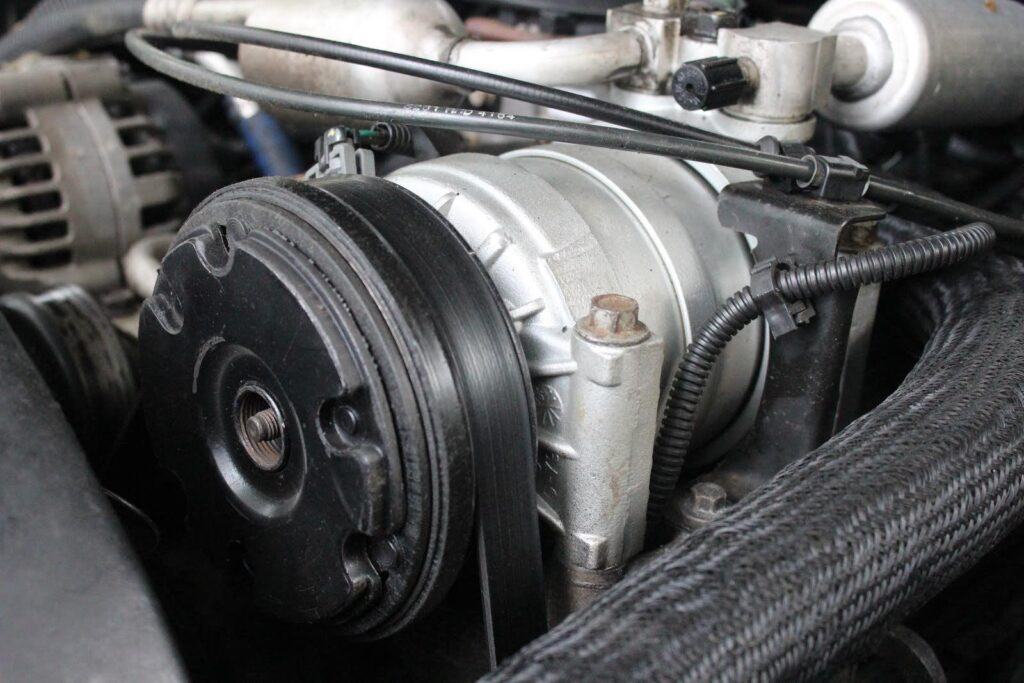
The air conditioning compressor circulates refrigerant through the cooling circuit. If it develops a mechanical or electrical fault, the system may struggle to produce cold air or stop cooling altogether.
Possible warning signs include unusual noises, poor cooling, intermittent operation or diagnostic faults relating to compressor control.
Some modern European vehicles use electronically controlled or variable-displacement compressors, so a compressor that isn’t cooling doesn’t necessarily need replacing. The control system, refrigerant charge and related components should be checked first.
Why it matters: If a compressor fails internally and contaminates the refrigerant circuit, the repair may involve additional components and cleaning procedures rather than simply fitting a new compressor.
2. Refrigerant Leaks and Damaged Condensers
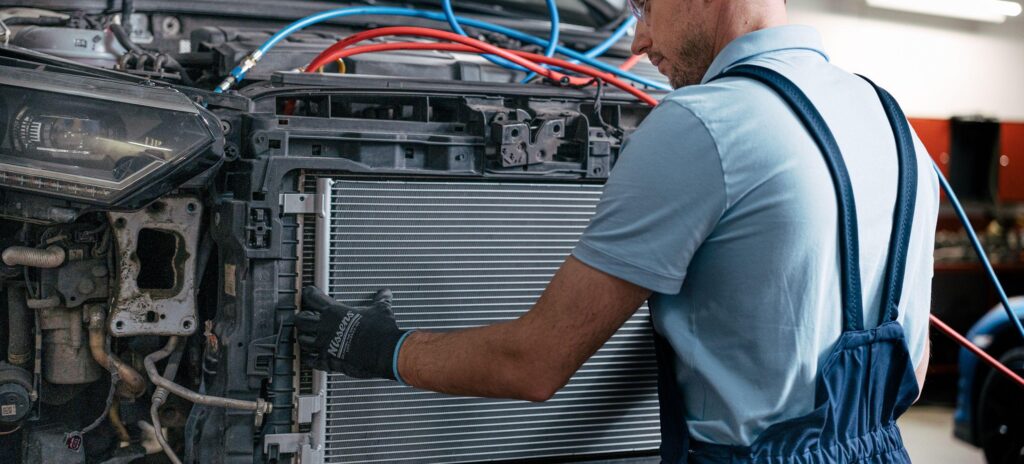
The condenser is usually mounted near the front of the vehicle, where it releases heat from the refrigerant. Its position means it can be exposed to road debris, corrosion and other damage over time.
Leaks can also develop at hoses, seals, fittings and other refrigerant-carrying components.
If a leak is suspected, the correct approach is to identify its location, assess the required repair and test the system before returning it to service. Simply adding more refrigerant may provide temporary cooling but won’t correct the leak.
3. Blower Motor and Cabin Airflow Problems
If the air coming from the vents is weak, the problem may have nothing to do with refrigerant.
A blocked cabin filter, faulty blower motor, electrical issue or ventilation restriction can reduce airflow, even when the refrigerant cooling circuit is working correctly.
Signs include little airflow at higher fan settings, a fan that works only at certain speeds or unusual noises from behind the dashboard.
4. Expansion Valve and Refrigerant Flow Problems
The expansion device helps control refrigerant flow into the evaporator. If a valve or related component develops a restriction or control problem, cooling performance may become poor or inconsistent.
Because these symptoms can resemble other refrigerant-system faults, pressure and temperature testing is important before deciding which component requires attention.
5. Evaporator Leaks and Unpleasant Cabin Smells
The evaporator is located within the vehicle’s heating and ventilation system, typically behind the dashboard. It absorbs heat from the cabin air to provide cooling.
Evaporator leaks can be difficult to access and may involve significant labour to repair. Separately, moisture and contamination around the evaporator or in the ventilation system can contribute to unpleasant smells.
A musty smell doesn’t automatically indicate a refrigerant leak. Cabin filter condition, moisture drainage and ventilation hygiene should also be assessed.
European Climate Control Failures: Why One Side Can Blow Hot and the Other Cold
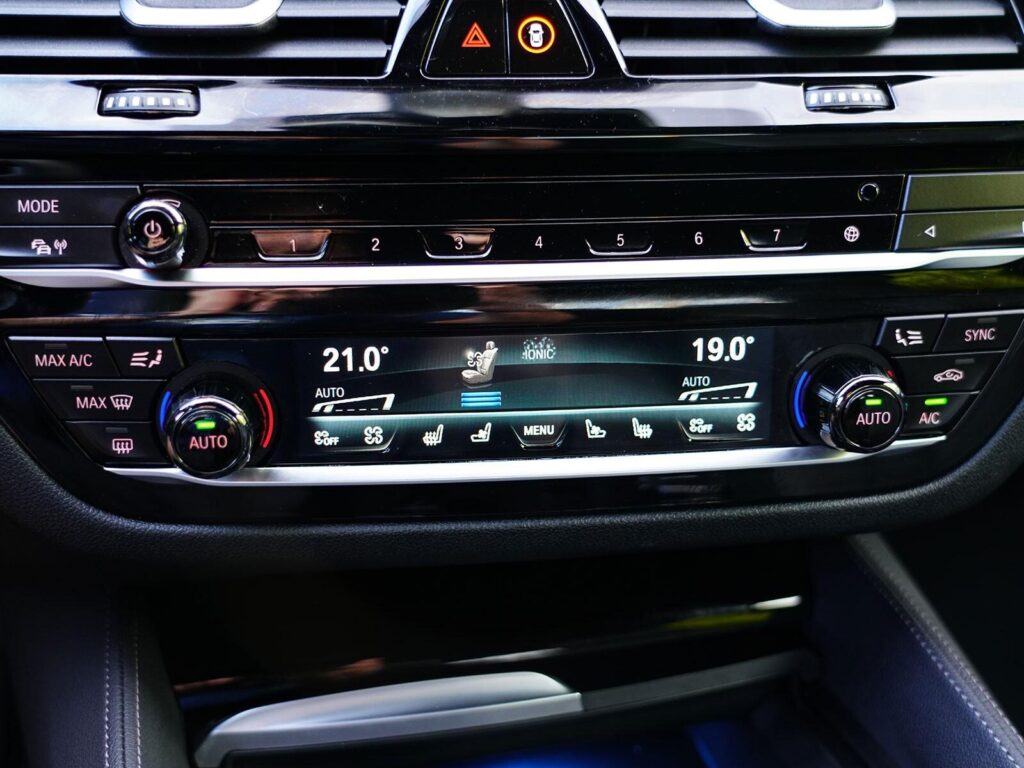
Many European cars feature dual-zone or multi-zone climate control, allowing different occupants to choose separate cabin temperatures.
These systems use temperature sensors, control modules, actuators and air-mixing doors to regulate airflow and cabin temperature. When one component stops working, the result can be confusing: the air conditioning may cool properly on one side of the vehicle but blow warm air on the other.
Common Electronic Climate Control Faults
- Blend-door actuator faults: Air-mixing doors may not move to the requested position.
- Temperature sensor problems: Incorrect readings can cause the system to regulate cabin temperature poorly.
- Control module faults: Electronic communication or control problems can affect climate functions.
- Blower control issues: The fan may operate intermittently or at incorrect speeds.
- Software or calibration problems: Some systems require diagnostic checks or actuator calibration after certain repairs.
These problems are one reason European climate control diagnosis should go beyond checking refrigerant pressure alone.
R134a vs R1234yf: Why Refrigerant Type Matters
Not every European car uses the same air conditioning refrigerant. Many older vehicles use R134a, while numerous newer models use R1234yf, a refrigerant with a much lower global warming potential.
The correct refrigerant is determined by the vehicle’s design and specifications, not simply by the badge on the bonnet or its age.
Different refrigerants require suitable servicing equipment and procedures. The wrong refrigerant or an incorrect charge can affect system operation and create safety or repair complications.
Before booking an air conditioning regas for a late-model BMW, Audi, Mercedes-Benz or Volkswagen, provide the workshop with your vehicle’s model and year so the required refrigerant and servicing arrangements can be confirmed.
Air Conditioning Problems in BMW, Audi, Mercedes-Benz and Volkswagen
Although the main principles are similar, European manufacturers use different climate control layouts and components. The correct diagnosis depends on the particular model, generation and equipment fitted.
BMW Air Conditioning & Climate Control Repairs
BMW models frequently feature automatic climate control with electronic temperature regulation and multiple ventilation settings.
If your BMW 3 Series, 5 Series, X3 or X5 has weak cooling, uneven cabin temperatures or intermittent airflow, possible causes include refrigerant-system faults, blower components, sensors and climate control actuators.
A proper BMW air conditioning diagnosis should establish whether the issue is in the refrigerant circuit, airflow system or electronic controls before recommending repairs.
Audi Air Conditioning & Dual-Zone Climate Control
Audi vehicles such as the A3, A4, A6, Q5 and Q7 may feature multi-zone climate control and electronically managed air conditioning components.
Uneven cooling, temperature control problems, compressor operation faults and poor airflow can have several causes. Diagnostic testing can help separate refrigerant-related issues from ventilation and electronic faults.
Mercedes-Benz Air Conditioning Repairs
Mercedes-Benz vehicles often use sophisticated automatic climate control systems, particularly in higher-specification models with multiple cabin zones.
If your C-Class, E-Class, GLC or GLE develops inconsistent cooling, unusual fan operation or a climate control warning, the issue may involve the compressor, sensors, blower system or electronic air distribution controls.
Diagnosing the system accurately helps avoid replacing expensive components unnecessarily.
Volkswagen & Škoda Air Conditioning Problems
Volkswagen and Škoda vehicles can use automatic climate control systems with electronic compressor regulation, temperature sensors and air distribution actuators.
Whether you drive a Volkswagen Golf, Tiguan, Passat or a Škoda Octavia, warm air or inconsistent cooling should be investigated systematically. A regas may be appropriate in some cases, but compressor control or electrical faults can produce similar symptoms.
Land Rover & Volvo Climate Control
Larger SUVs such as the Land Rover Discovery, Range Rover, Volvo XC60 and Volvo XC90 may have additional climate zones and more complex cabin ventilation arrangements.
Problems affecting rear-seat cooling, uneven temperatures or airflow distribution may require checks of the climate control electronics and ventilation system as well as the refrigerant circuit.
How Much Does European Car Air Conditioning Repair Cost?
European car air conditioning repair costs vary depending on the cause of the problem, the refrigerant used, parts availability and how accessible the affected component is.
A routine performance check or correctly performed regas is a very different job from replacing a compressor, repairing a refrigerant leak or removing dashboard components to access an evaporator.
| Service or Repair | Main Cost Factors | What to Know |
|---|---|---|
| AC inspection and diagnosis | Testing time, electronic checks and fault complexity | Establishes whether regassing or repairs are required |
| Air conditioning regas | Refrigerant type, charge quantity and required testing | Appropriate only when the system is suitable for recharging |
| Leak detection and repair | Leak location, component access and replacement parts | The underlying leak must be addressed |
| Condenser replacement | Parts, access, refrigerant recovery and recharge | May require removal of front-end components |
| Compressor repair or replacement | Compressor design, parts and possible system contamination | Can be a significant repair |
| Climate control actuator repair | Dashboard access, diagnostics and calibration | Costs vary widely by vehicle layout |
| Evaporator replacement | Labour-intensive access and refrigerant-system work | Can be expensive if major dashboard disassembly is needed |
Because repair costs vary so much between European models, a reliable quote should follow proper diagnosis. When contacting a workshop, provide the make, model, year and a description of the symptoms.
What Happens During a Professional Car Air Conditioning Service?
A professional air conditioning assessment should focus on finding the cause of the problem before deciding what work is needed.
- Discuss the symptoms: Does the system blow warm air all the time, only at idle or only from certain vents?
- Check cooling performance: Assess vent temperatures, airflow and relevant operating conditions.
- Inspect system operation: Check compressor control, cooling fans, sensors and associated components as appropriate.
- Investigate refrigerant condition and leaks: Carry out suitable testing using approved equipment and procedures.
- Diagnose electronic faults: Read relevant fault information and test climate control components where necessary.
- Explain the findings: Identify the recommended repair and provide a quote before proceeding.
- Complete repairs and verify performance: Carry out the required work, recharge the system correctly where applicable and confirm operation.
This approach helps avoid repeated regassing when the actual problem is a leak, faulty compressor or electronic climate control component.
Can You Prevent Expensive Air Conditioning Repairs?
Not every air conditioning failure is preventable, but a few sensible maintenance habits can help keep the system operating effectively.
- Use the air conditioning periodically in accordance with the vehicle manufacturer’s guidance.
- Replace cabin filters at the recommended intervals.
- Investigate reduced cooling before the system stops working completely.
- Have unusual compressor or blower noises checked.
- Keep exterior air intakes free of leaves and debris where accessible.
- Arrange proper diagnosis if the system repeatedly loses cooling performance.
- Have refrigerant-related work performed by appropriately licensed technicians.
For Brisbane drivers, checking air conditioning performance before the hottest months can make it easier to address problems before reliable cooling becomes essential.
The Biggest Air Conditioning Mistakes to Avoid
- Assuming warm air always means low refrigerant: Electrical and mechanical faults can cause the same symptom.
- Repeatedly regassing a leaking system: A leak needs to be identified and repaired.
- Ignoring weak airflow: The issue may be a cabin filter or blower fault rather than the cooling circuit.
- Replacing a compressor without diagnosis: Compressor control and related components should be tested first.
- Using DIY refrigerant top-up products: Incorrect charging or incompatible products can create further problems and refrigerant handling is regulated.
- Ignoring demisting problems: Reduced ventilation and air conditioning performance can affect visibility.
Frequently Asked Questions About European Car Air Conditioning
How do I know if my car needs an air conditioning regas?
Poor cooling can indicate an incorrect refrigerant charge, but it can also result from compressor, electrical or climate control faults. Testing is needed to determine whether a regas is appropriate and whether a leak or other problem needs repairing.
How often should European car air conditioning be regassed?
There is no universal regas interval for every European vehicle. A properly sealed system may operate for years without needing a recharge. If cooling performance declines, the system should be checked rather than automatically topped up.
Why is my BMW or Audi air conditioning blowing warm air?
Possible causes include refrigerant loss, compressor problems, cooling fan faults, sensors or electronic climate control issues. The correct diagnosis depends on the vehicle and its symptoms.
Why is my Mercedes air conditioning cold on one side but hot on the other?
Uneven temperatures can result from a blend-door actuator, temperature sensor or climate control fault. Refrigerant-system issues can also affect cooling distribution on some vehicles, so diagnosis should consider the complete system.
Can a car air conditioning leak be repaired?
Yes. Many leaks can be repaired by replacing a damaged seal, hose, condenser or other component. The correct repair depends on the leak’s location and the condition of the system.
Is an air conditioning compressor expensive to replace?
Compressor replacement can be a significant expense, particularly if additional components require replacement or the system has been contaminated. Proper diagnosis is important before authorising the work.
Does car air conditioning help demist windows?
Yes. Air conditioning can help remove moisture from cabin air, improving demisting performance. If your windows take unusually long to clear, the ventilation and climate control systems may need attention.
Can an independent European car specialist repair climate control systems?
Yes. A suitably equipped workshop can diagnose and repair many European vehicle air conditioning and climate control problems. Refrigerant handling requires appropriate licensing, and certain model-specific procedures may require specialised equipment.
European Car Air Conditioning Repairs & Regas | Windsor & Grange, Brisbane
If your European car’s air conditioning has stopped cooling, is making unusual noises or isn’t maintaining the right cabin temperature, getting the problem checked early can help avoid unnecessary repairs and uncomfortable driving.
At Memmotts Automotive, we provide car air conditioning servicing, regassing, fault diagnosis and repairs from our two Brisbane northside workshops. We work on all makes and models, with a particular focus on European vehicles including BMW, Audi, Mercedes-Benz, Volkswagen, Land Rover and Volvo.
Why Choose Memmotts Automotive?
Family-owned since 1956, Memmotts Automotive combines experienced technicians, professional diagnostic equipment and straightforward advice. We focus on identifying the cause of your air conditioning problem and explaining the recommended work before repairs begin.
With workshops in Windsor and Grange, we assist drivers across Brisbane’s northside, including Lutwyche, Wilston, Stafford, Albion, Newmarket, Gordon Park and surrounding suburbs.
Need an air conditioning regas or European climate control repair in Brisbane? Contact our team or book an assessment at the workshop that suits you.
Explore our car air conditioning services | Book a service online